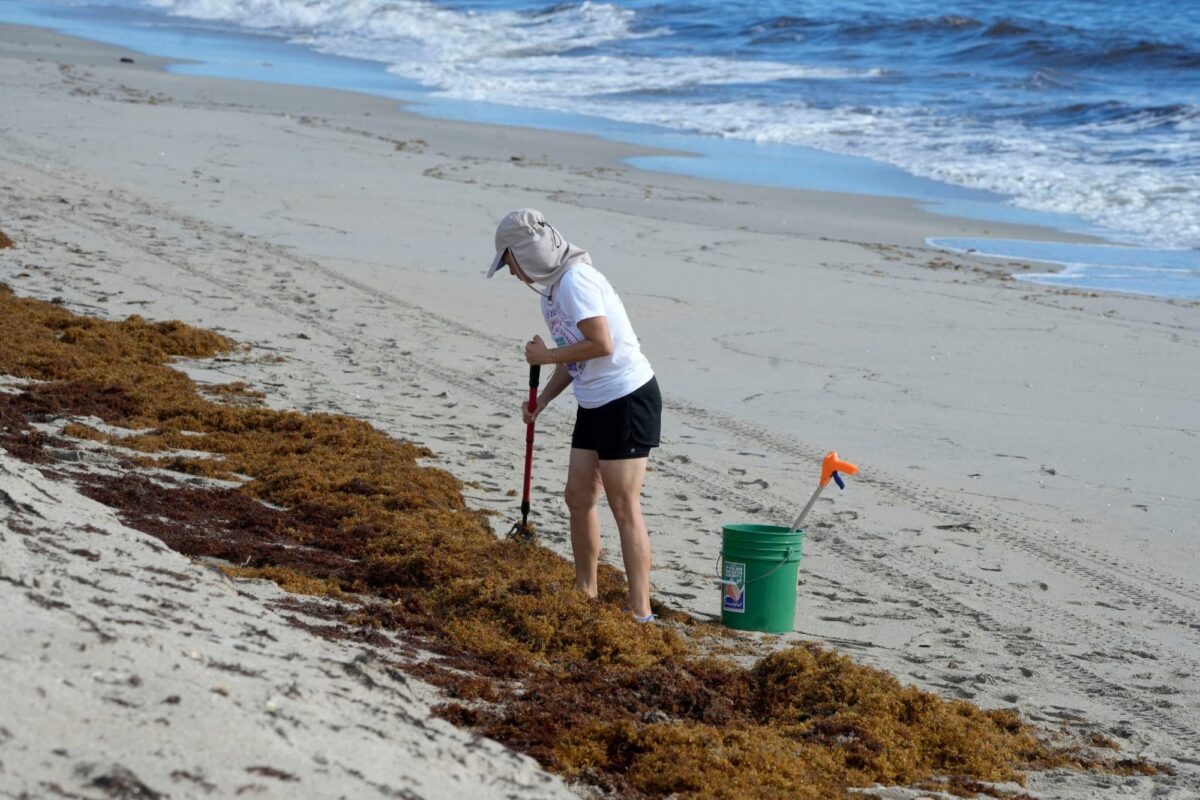
Nothing ruins the beauty of a beach day faster than masses of shaggy brown seaweed floating in the water and piled on the sand. Called sargassum, this algae has become an increasingly common sight on beaches across the coastal South — and there’s no sign of it stopping anytime soon.
According to researchers at the University of South Florida’s College of Marine Science, 2025 and 2026 had the highest amounts of sargassum on record. In June 2026, 5 million metric tons of it washed up on the Gulf Coast alone. Here’s what beachgoers need to know.
What is sargassum?
This type of algae forms leafy clumps and ranges from deep yellow to brown. Sargassum has small, round, air-filled orbs that are mostly filled with oxygen, which allows it to float on the surface of the water. When it washes up on the shore and decomposes, it produces hydrogen sulfide gas, which has an unpleasant smell, like rotten eggs. People with asthma or other respiratory conditions might be especially sensitive to this odor.
Why is there so much of it?
The seaweed was mainly found in the Sargasso Sea, but in 2011, scientists began noticing massive amounts of it in the Atlantic Ocean stretching all the way from west Africa to the Gulf Coast, which they called the Great Atlantic Sargassum Belt. The belt is formed by ocean currents and winds, and can appear like a gigantic carpet of seaweed. Satellites measured 33.5 million tons of sargassum in June 2026.
Is sargassum safe to touch?
Sargassum is safe to touch. However, Florida’s Department of Health recommends avoiding skin contact because the small crabs, jellyfish and other sea creatures living in the seaweed, not the seaweed itself, might cause skin irritation.
Is sargassum good or bad?
It’s complicated. On land, masses of seaweed are bad for local tourism and fishing economies and can clog pipes. Plus, the cost of cleanup is high. On the other hand, in the ocean, sargassum is an important source of food and shelter for fish, sea turtles and birds.
When is sargassum season?
Sargassum peaks in the warmer months, like June and July, then tapers off in the fall and winter. If you’re curious about the levels in your area or a vacation destination, the National Oceanic and Atmospheric Administration (NOAA) has a tool that provides daily reports on the amount of sargassum in Florida and other coastal areas.