
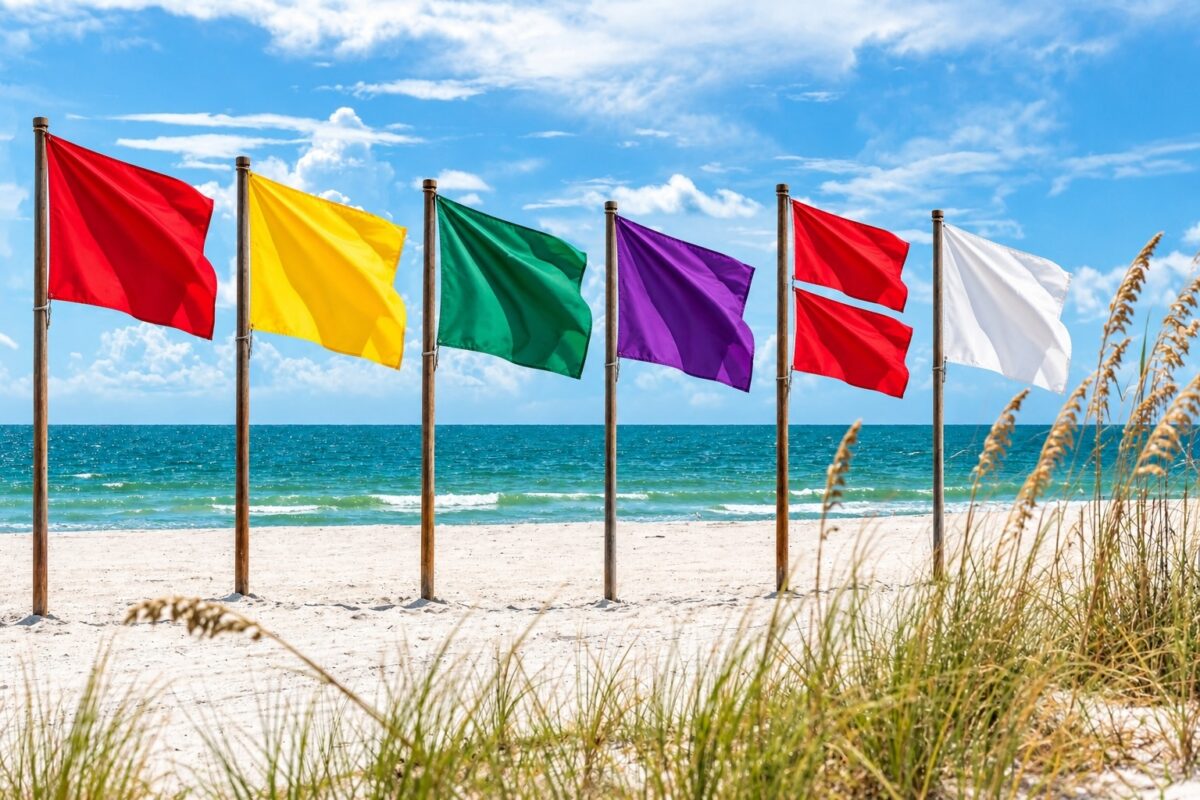
You’ve got your umbrella, towel, folding chair and you even remembered the sunscreen — an afternoon at the beach awaits. But before you even set foot on the sand, you notice a bright red flag flapping in the breeze over the lifeguard station. Uh-oh.
A literal red flag is a clear sign that something’s wrong, but should you turn around and head home? And what about a yellow flag? Or an orange wind sock? There are actually nine different beach warning flags established by the International Life Saving Federation (ILS), and each one addresses a different potential hazard.
What are the beach warning flags, and what do they mean?
Yellow
This color indicates a medium hazard level, meaning moderate surf and/or currents are present. Use extra care when swimming.
Red
A red flag means that swimmers are discouraged from entering the water due to high-hazard conditions such as strong currents or surf.
Double Red
The water is closed to the public.
Purple
When this flag is flying, marine pests that can cause minor injuries, such as jellyfish or stingrays, are in the water.
Red/White
Pay attention if you see this flag, which signals that swimmers should leave the water immediately. This flag is usually used in emergency situations such as the presence of sharks (or other potentially dangerous marine life) or water contamination. Lifeguards may also fly this flag when they need to search the water.
Red/Yellow
While this bold color combination might look alarming, it just means that the area is protected by lifeguards and swimming is permitted. Often, two flags are used to designate the boundaries of the protected area.
Black/White
These flags are often used in pairs to designate an area where surfboards and other non-powered watercraft can be used.
Yellow with Central Black Ball
Surfboards and non-powered watercraft are prohibited.
Orange Windsock
This cone-shaped flag indicates the direction of offshore winds and means that it is unsafe to use inflatable objects, such as inner tubes and rafts.
What about green flags?
You may see green flags flying from lifeguard stands to indicate that the water is calm and safe for swimming, but the ILS doesn’t officially endorse this flag. The organization believes that hazards can always arise in the ocean, and the flags should only be used to alert people to those dangers.